

A Numeric Approach to Software Selection
Discover how a Quality Functional Deployment (QFD) and a scoring system can assist your software or technology selection, turning a complex decision into a clear, number-driven choice.


👋 Hey, it’s Sara. Welcome to my weekly newsletter where I share insights to become more efficient. Each week, there will be a featured article, a glimpse into technology, a throwback to the past, and community conversation.
Read time: 6 minutes
“What you choose also chooses you.” ― Kamand Kojouri
Several years ago, I led a program to implement an enterprise quality management software solution. As the program manager, the platform recommendation was in my hands. This platform would be used by multiple teams for various business processes. A bad decision could set the program up for failure, waste money, and ruin my career. I turned to my Lean Six Sigma toolkit for help and found the Quality Functional Deployment (QFD) tool to be the best solution to this dilemma. The result has been shared with many people and is considered a best practice.
A QFD is a tool that provides a structured approach to aligning a design to the customer’s needs. To complete a QFD, a House of Quality is created. The process below is a modified version, suited specifically for software or technology selection.
Step 1: Identifying Customer Needs
The first step is to identify all of the customers / stakeholders of the product. Here are some parties to consider:
Users of the application
Financial decision-makers
IT department, including infrastructure and cyber security
Process owners
Regulatory bodies
Third-party users - suppliers or customers
Once the customers are identified, collect feedback directly and independently. For my program, this was done during a brainstorming session where the people recorded their requirements on post-it notes. Our list had over 100 ideas included! To digest the needs, rationalize the list to eliminate duplicate ideas and categorize them into key requirements.
The requirements should include vendor selection - is the vendor reputable, financially stable, and provides adequate support?
Step 2: Scoring the Relative Importance
The next step is to assign an importance value to each requirement. Each of the requirements identified by the customers is given a rank of 1, 3, or 9, with 1 being the lowest importance and 9 being the highest. This scoring creates differentiation of the most important customer needs. The discussion should happen in a meeting with a representative from the different customer groups. A best practice is to limit the team to 5-6 people for the discussion, to reach consensus faster. Upon completion, the final recommendation can be shared more broadly.

Step 3: Finding Options
Casting a wide net to explore options is easy when you leverage online resources. Utilize search engines, tech blogs, and industry forums. Websites like Capterra, G2, or TechCrunch offer comprehensive lists and reviews of various software options. You can use the requirements from Step 1 to narrow down the options to a shorter list (3-5).
From here, you’ll want to learn more about the products so that you can accurately evaluate the product against the requirements. Here are some suggestions:
Attend Trade Shows and Webinars: These events are great for discovering emerging technologies and networking with vendors and other users.
Seek Recommendations: Ask for suggestions from peers, industry groups, or through social media channels. Personal experiences from similar users can be invaluable.
Onsite or Online Demos from Existing Customers: the best method to evaluate software is to see it in use at another company. If possible, meet with existing customers in person and without the vendor present to get a fair assessment.
Step 4: Score the Requirements for each Solution
To score the application rate of each of the solutions against each requirement. Use the following guidelines for scoring:
9 - the application meets the requirement
3 - the application kind of meets the requirement
1 - the application meeting the requirement is a stretch
0 - the application does not meet the requirement
If you need more hands-on experience to create an accurate score, consider signing up for a free trial, or asking the vendor for a sandbox environment to text. While this may be time-consuming, proper selection will save time and frustration later.

Step 5: Tally Each Solution Option
The final score for each solution is the sum of the product (requirement importance * application rating). Here’s an example:
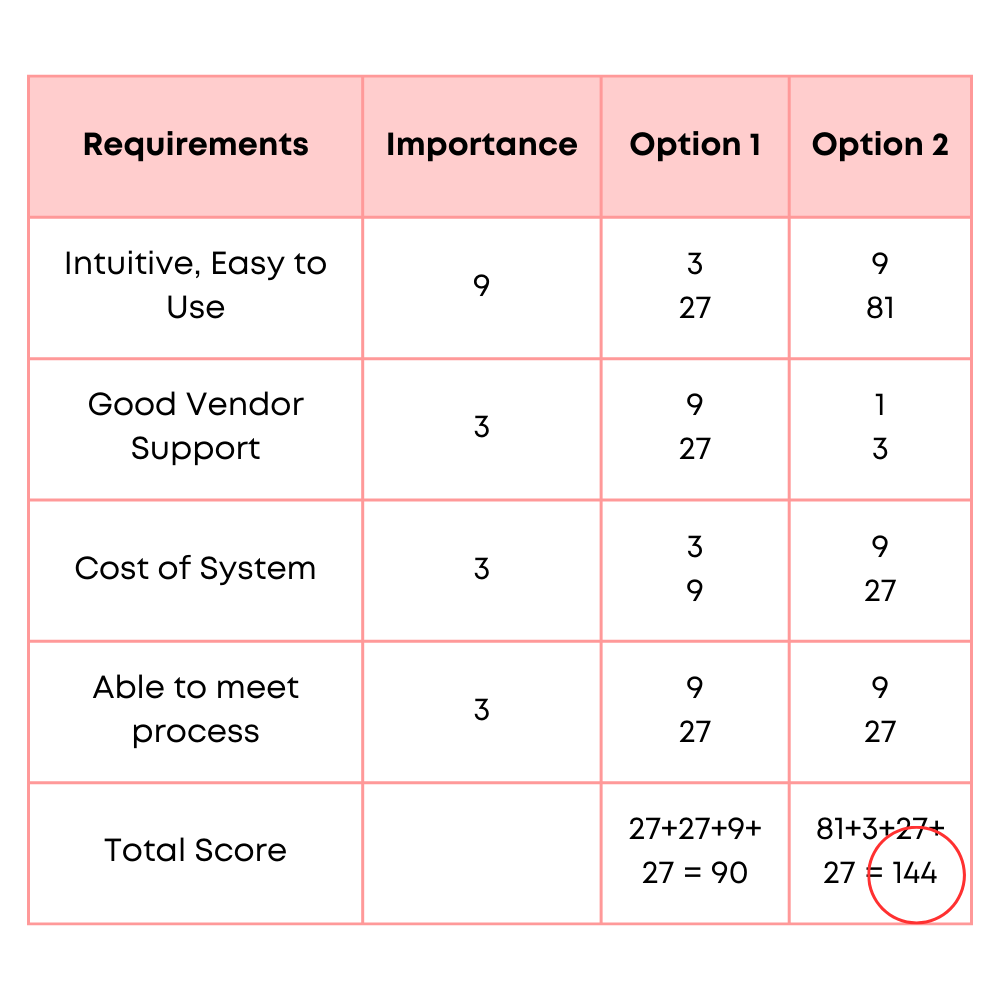
The top-scored application is the mathematically calculated selection, based on the collaboration and input of all stakeholders. In the case of the quality management software, our top application was not in alignment with the leadership’s preferred partner. The data backed up the decision and we moved forward with the program.
In summary, the decision to use a QFD to assist in the major decision of platform selection turned out to be effective. I’ve used it for several other decisions, including personal ones.
I’m curious. Would anyone like a template?
Tech Spotlight: How a QFD can be used to select an AI Chatbot
I thought it would be fun to assess a couple of common AI Chatbots to see which one would be recommended. I used the following article as the basis for the assessment: AI Chatbot Comparison. The diagram below represents my assessment based on the article.
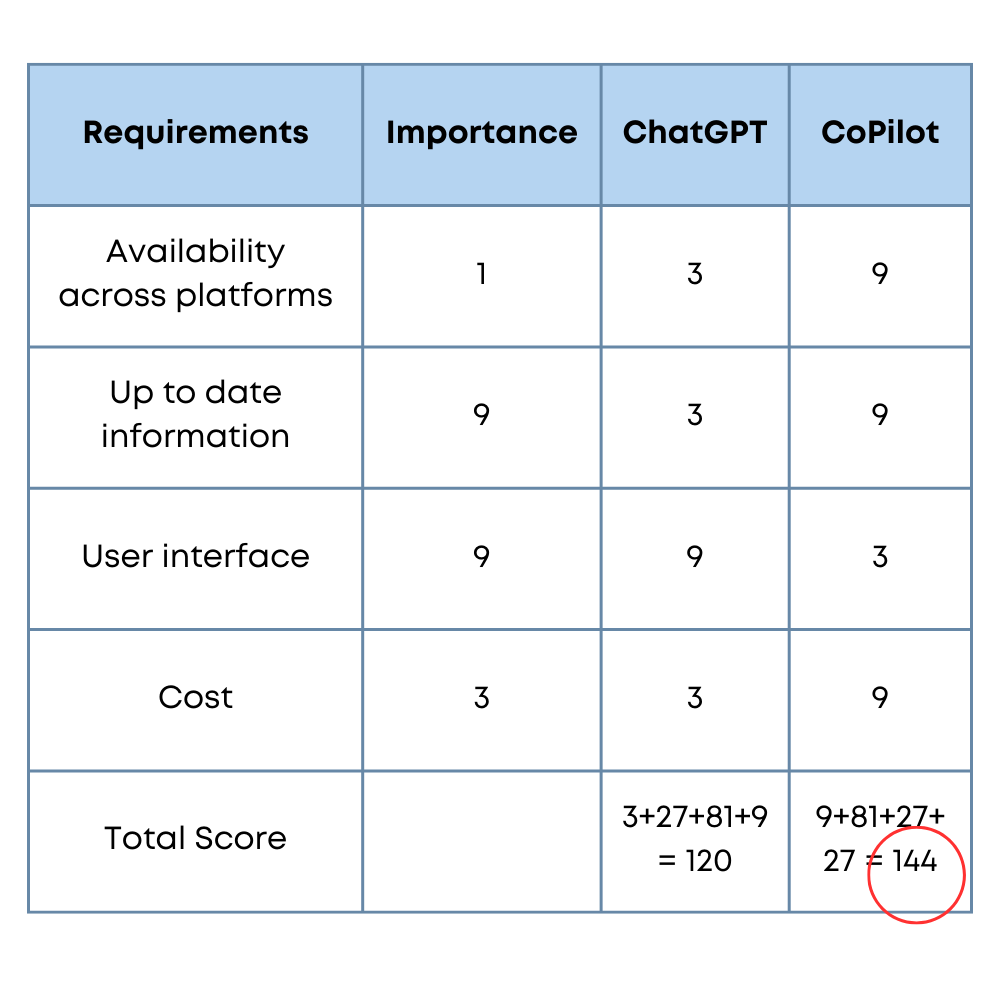
I’ve been a subscriber to ChatGPT 4.0 for a while and will likely continue to use it over Microsoft Co-Pilot, at least for now. The main reason is that the screen is easier to digest and fits into my overall workflow better.
Throwback Feature
The Quality Functional Deployment (QFD) was developed by Yoji Akao during his tenure at Mitsubishi in 1966.
Yoji Akao's rationale for a QFD was centered around the concept of translating customer requirements, which are often qualitative, into clear, quantitative parameters. Essentially, a QFD provides a systematic framework to ensure that customer needs are considered throughout the design and production process, allowing for a more targeted and efficient approach to achieving high-quality outcomes.
This innovative approach was later adopted by Toyota and several other automotive manufacturers, marking a significant shift in quality management and design methodologies.
Community Conversation
Our question this week comes from an AMA (ask me anything) post on LinkedIn. Jess asked, “What's the strangest thing that you've ever asked ChatGPT?”
I use ChatGPT (for personal reasons, there is a company-approved Bot for work) for many things: getting dinner ideas from my pantry items, looking for song suggestions for dance class, writing emails, and summarizing text. Nothing strange about that. However, earlier that evening, I had seen a post from a Sales Influencer that contained 25 hook statements for LinkedIn Posts.
I copied the post into ChatGPT and asked it to convert the hooks into statements that would come from a project manager vs. an expert in Sales. Here are a few of the failed translations:
"Looking for Your Next Breakthrough in Project Growth?”
"Elevate Your Projects Above the Competition?"
"Transforming Prospects into Successful Projects?"
What is the strangest thing that you’ve asked ChatGPT?
***I encourage people to ask questions in the comments of the newsletter. If I don’t have an answer, I’ll do the research and share what I find.***
Thank you for being a part of our journey. If you’ve found value in our conversation, please consider sharing this newsletter with others who might benefit and contribute.
Until next time, thank you for your support and curiosity.
— Sara 🙋♀️
Thanks for reading The Efficiency Explorer! Subscribe to receive new posts.
© 2024 Leverage4Data LLC
Erie, PA 16415, USA
*** My views are my own. ***